
When you’re about to frame a wall — whether it’s a home addition, a commercial tenant improvement, or a remodel — the choice between wood studs and metal studs can have a significant impact on material cost, labor hours, wall thickness, and ultimately your project’s bottom line. In Tyler, TX, making the right decision can set your project apart for durability, speed, and budget control.
This guide not only explains the differences between these two framing materials, but it also shows how factors like stud spacing, wall thickness, and building type (residential vs. commercial) influence cost — and how you can use our interactive Framing Calculator to plug in wall types and see how the pricing varies in real time.
1. What’s the Difference: Wood vs Metal Studs
Wood Studs
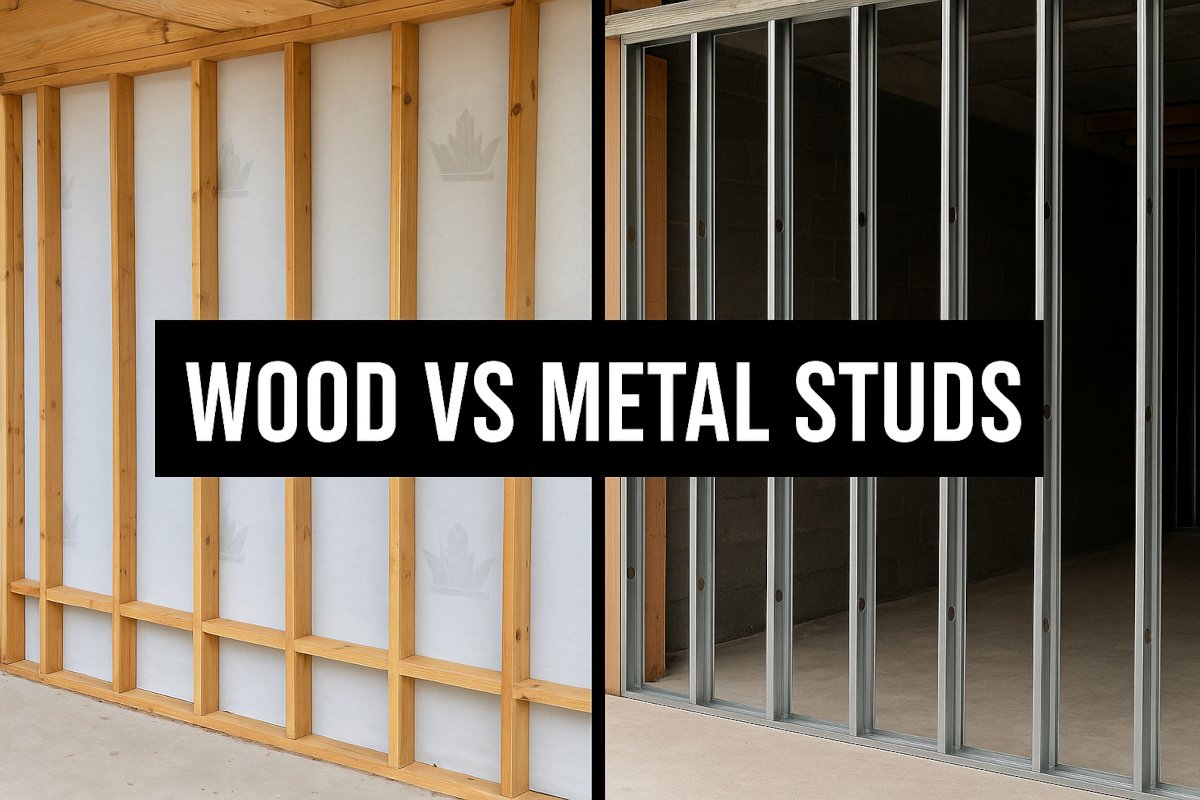
Wood studs (commonly 2×4 or 2×6 Spruce–Pine–Fir #2) remain the standard for residential framing in the Tyler area. They’re easy to cut and modify onsite, compatible with most standard drywall and sheathing systems, and their cost per piece tends to be lower than metal.
Pros: familiar to most crews, easy to modify, good thermal performance.
Cons: susceptible to moisture/rot if not protected, can warp or twist, variable cross-section and tolerances.
Metal Studs
Metal studs (cold-formed steel sections) are widely used in commercial construction, interior tenant upgrades, and places where fire-resistance, straightness, and consistent dimensions are important.
Pros: extremely straight, resistant to moisture/rot/insects, consistent quality, faster to align.
Cons: higher material cost, may require different tools or fasteners, thermal bridging can be an issue in exterior walls.
2. Cost Impact by Wall Type and Spacing
Stud Spacing (OC – on-center)
One of the biggest variables in cost is stud spacing. Common spacings: 12″, 16″, 24″ (imperial) or 300 mm, 400 mm, 600 mm (metric).
- Closer spacing (12″ OC): more studs, higher material cost, higher labor, but stronger support for heavy loads.
- Typical spacing (16″ OC): standard for many residential walls, balanced cost vs. performance.
- Wider spacing (24″ OC): fewer studs, lower material cost, but may require stronger sheathing or blocking.
Wall Thickness & Insulation
When you move from 2×4 to 2×6 wood studs or equivalent metal sections, you increase wall thickness, insulation capacity and structural strength — but also raise material and labor cost. Metal studs may allow thinner cross-sections in some internal walls, but for exterior walls they may require additional insulation or vapor control, increasing cost.
Residential vs. Commercial Application
- Residential (Tyler homes, additions): Wood studs dominate; cost sensitivity is higher.
- Commercial (tenant finishes, offices, retail): Metal studs often preferred due to speed, straightness, fire codes, and less waste-on-site. While the material cost is higher, labor savings and schedule reliability often justify it.
3. Why Our Interactive Tool Matters
With our Framing Calculator, you can choose your wall type, stud spacing, corners, T-walls and openings, and instantly see how the cost, materials, and labor hours shift.
It’s not just theoretical — it’s local to Tyler, TX. Use it to:
- Model wood studs at 16″ OC vs. metal studs at 24″ OC and compare cost differences.
- Understand how adding a second top plate or using 2×6 studs impacts cost.
- Choose “commercial grade” metal framing and see how labor hours change.
- Instantly print your results for builders, clients or bidding.
4. Material Reference Table
| Element | Material | Usage / Notes |
|---|---|---|
| Common Studs | 2×4 or 2×6 SPF #2 (wood) | Main vertical frame; residential standard. |
| King Studs | 2×4 or 2×6 SPF #2 (wood) | Flank openings. |
| Jack Studs | 2×4 SPF #2 (wood) | Under headers of openings. |
| Cripple Studs | 2×4 SPF #2 (wood) | Short studs above or below openings. |
| Corner Studs | 2×4 SPF #2 (wood) | Reinforce corners / junctions. |
| T-Walls Studs | 2×4 SPF #2 (wood) | For perpendicular wall intersections. |
| Plates (Top/Bottom) | 2×4 or 2×6 SPF #2; bottom PT if concrete | Horizontal members at top and bottom of wall. |
| Sheathing Panels | 7/16″ OSB or ½″ CDX plywood | Covers wall framing, 4×8 ft sheets. |
| Metal Studs (Commercial) | C-sections cold-formed steel | Used in interior, commercial, high-precision framing. |
5. Example Scenario
Let’s imagine a wall in Tyler, TX:
- Length: 30 ft
- Height: 8 ft
- Stud Spacing: 16″ OC
- Corners: 2
- T-Walls: 1
- Openings: 2 windows + 1 door
Scenario A: Wood framing (2×4, 16″ OC)
- Common studs: 17 pcs
- King studs: 4 pcs
- Jack studs: 4 pcs
- Cripple studs: 2 pcs
- Corner studs: 4 pcs
- T-wall studs: 2 pcs
- Top plates: 60 LF
- Bottom plate: 30 LF
- Sheathing: 12 panels (4×8)
- Estimated crew hours: 6.1 hours (3-person crew)
Scenario B: Metal framing (C-studs, 24″ OC, commercial grade)
- Common studs: fewer pieces (e.g., 13 pcs)
- King studs: same or slightly more due to heavier load conditions
- Labor hours may drop by ~10-20% due to speed and straightness
- Material cost higher per stud, but labor cost may offset
- Sheathing remains similar unless upgraded
6. How to Choose for Your Project in Tyler
- Budget-sensitive residential job: Wood studs, 16″ OC, standard sheathing works great.
- High-end residential or scenarios needing extra insulation: Consider 2×6 wood or metal studs with insulation improvement.
- Interior commercial tenant improvements: Metal studs deliver straight edges, faster alignment, less waste — ideal for retail or office finishes.
- Check local code & framing contractor: In Tyler, TX, local framing contractors (like our team at East Texas Construction) can advise on cost and availability of wood vs metal.
7. Local Call To Action
Ready to move forward? Use our free interactive Framing Calculator, tweak your wall options, and get a detailed materials list and labor estimate tailored to Tyler, TX.
📞 Call us today at (903) 245-5824 or
📍 Visit us at 7524 S Broadway Ave #110, Tyler, TX 75703 (Mon-Sat 8 AM-6 PM).
East Texas Construction – Your local framing experts in Tyler.