

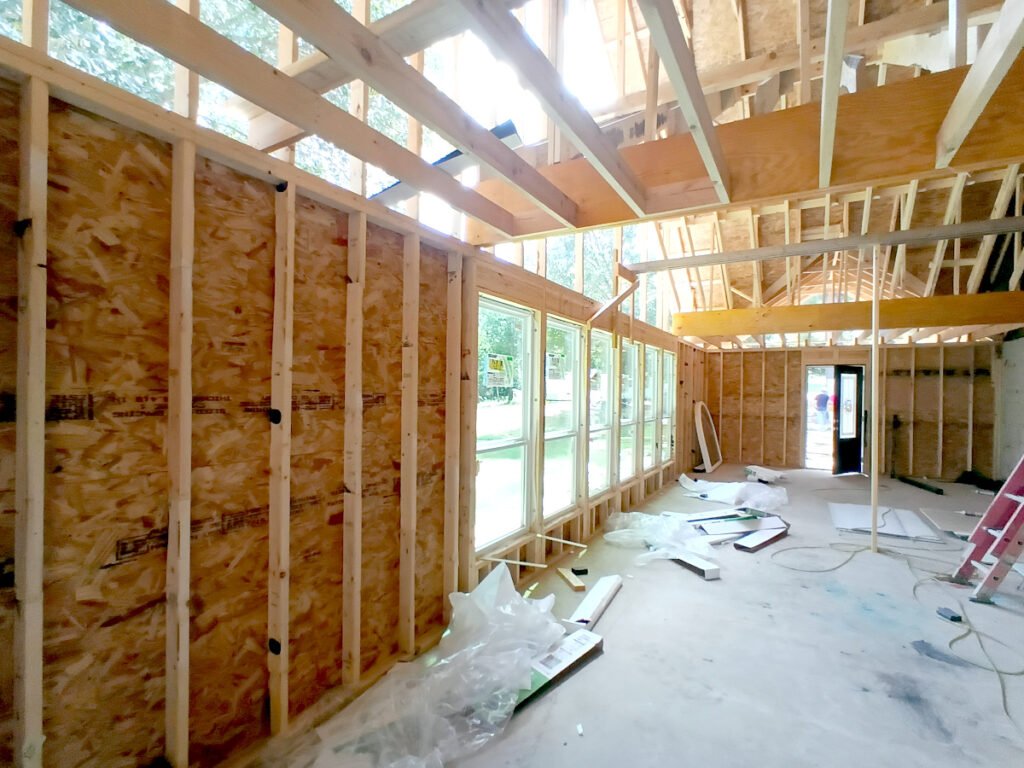
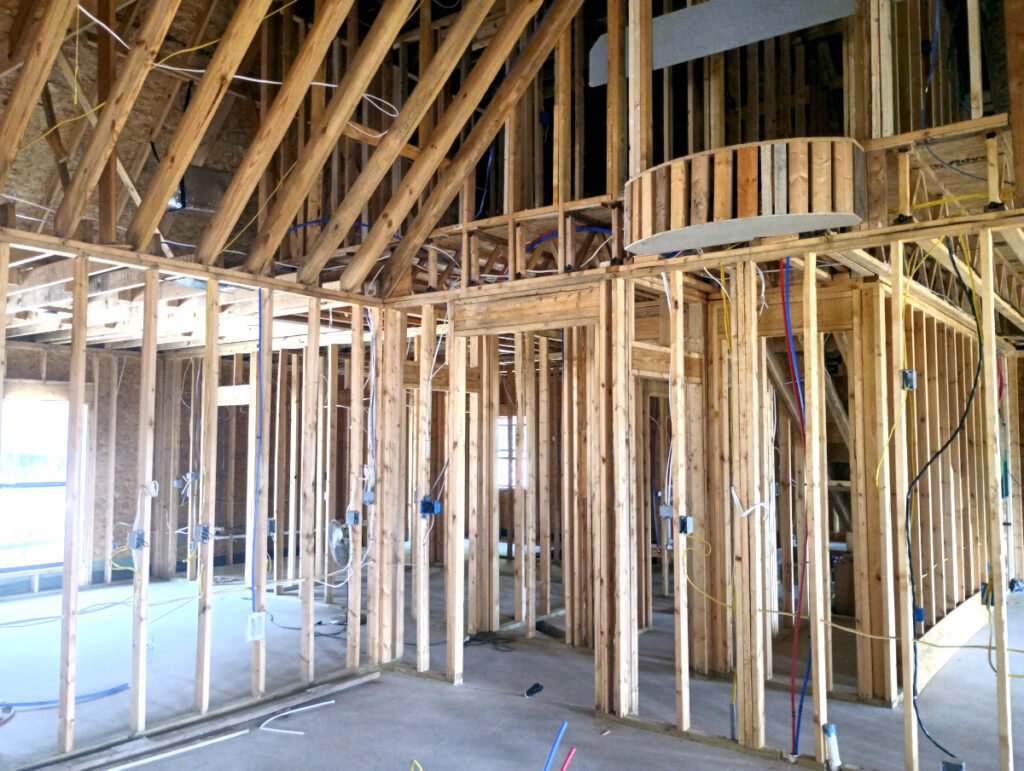
All in one click — with results ready to print or share with clients or your construction crew.
Enter Wall Dimensions
Length: total wall length in feet (or meters).
Height: wall height.
Stud Spacing: choose 12″, 16″, or 24″ OC (or metric equivalents).
Add Corners & T-Walls
Corners = end points of walls or room transitions.
T-Walls = intersections where perpendicular walls join.
Add Doors and Windows
Click “+ Add Opening” and enter:
Type: Door or Window
Width & height (in inches or mm)
Kings (typically 2 per opening)
Jacks per side (usually 1)
Calculate
Press “Calculate” and instantly see:
Materials list
Labor breakdown
Sheathing area and waste
Geometry summary
Print Your Results
Use the “Print Results” button to create a clean, professional summary ready for jobsite use or client presentation.
Framing Calculator
Units: IMPERIAL | Preset: residential-exterior
Results
Understanding the Results
🧱 Materials — Studs
| Type | Meaning | Typical Material |
|---|---|---|
| Common Studs | Regular vertical studs along the wall | 2×4 or 2×6 SPF #2 |
| Kings | Full studs beside openings | 2×4 or 2×6 SPF #2 |
| Jacks (Trimmers) | Short studs under headers | 2×4 SPF #2 |
| Cripples | Short studs above/below windows | 2×4 SPF #2 |
| Corners | Extra studs at wall intersections | 2×4 SPF #2 |
| T-walls | Studs for perpendicular joints | 2×4 SPF #2 |
| Removed (openings) | Studs eliminated by openings | — |
🪵 Materials — Plates
| Type | Description | Typical Material |
|---|---|---|
| Top Plates | Horizontal members at top (often double) | 2×4 or 2×6 SPF #2 |
| Bottom Plate | Base plate on floor | 2×4 or 2×6 SPF #2 PT if touching concrete |
| Sill Pieces | Under window openings | 2×4 SPF #2 |
🧩 Blocking / Bracing
Adds horizontal reinforcement between studs to prevent buckling.
- 1 blocking row for walls ≤8 ft
- +1 row for every 4 ft of added height
- Calculated in linear feet (LF) and 8 ft pieces.
🪵 Sheathing (4×8 Panels)
Calculates:
- Net area (ft²) of wall minus openings
- Total 4×8 panels needed
- Waste percentage (adjustable in Settings)
Default material:
- 7/16″ OSB (standard residential sheathing)
- Optional upgrade: ½” CDX plywood
⏱ Labor — Crew Hours
The calculator estimates total framing time based on customizable productivity rates.
| Task | What It Means | Default Rate |
|---|---|---|
| Studs | Installing studs | 14 studs/hour |
| Plates | Cutting & installing top/bottom plates | 50 LF/hour |
| Openings | Framing doors & windows | 0.8 h each |
| Cripples | Installing short studs | 0.12 h each |
| Sills | Window base sills | 0.15 h each |
| Crew Hours | Total labor estimate | Automatic |
- Structural rigidity
- Fire blocking
- Drywall support
- Backing for cabinets or rails
- 7/16″ OSB (Oriented Strand Board) — standard for residential framing.
- 1/2″ CDX Plywood — higher strength and moisture resistance.
Standard size: 4×8 ft (1.22×2.44 m)
Effective coverage: 32 ft² per panel after overlaps.
How the Framing Calculator Works
Our Framing Calculator uses real framing logic to estimate the quantities of materials and the labor hours required for each wall or structural segment. Below you’ll find how each component is calculated and interpreted.
1️⃣ Materials — Studs
Purpose: Determine how many vertical framing members (studs) are needed per wall segment.
Calculation Steps:
- The calculator takes the wall length, height, and stud spacing (e.g., 16” or 24” on center).
- It divides the wall length by the spacing, adds 1 stud at each end, and adjusts for corners, T-walls, and openings.
- Additional stud types are included:
- King studs: 2 per opening (one on each side).
- Jack studs: support the header, 1–2 per opening.
- Cripple studs: short studs above or below openings.
- Corner and T-wall studs: structural reinforcements for connections.
Formula Example:Common Studs = ceil(Wall Length / Spacing) + 1
Then adjust for removed openings and add kings, jacks, corners, and T-walls.
2️⃣ Materials — Plates
Purpose: Calculate the linear footage (LF) of top and bottom plates used in wall framing.
Calculation Steps:
- Top plates: Two runs of lumber across the entire wall (double top plate).
LF_top_total = wall_length × 2 - Bottom plate: One run across the bottom.
LF_bottom_total = wall_length - The total footage is divided by 8 ft (standard board length) to find how many pieces are required.
Result Example:
For a 20 ft wall → top plates: 40 LF (5 boards), bottom plate: 20 LF (3 boards).
3️⃣ Blocking / Bracing
Purpose: Reinforce tall walls and prevent stud movement.
Calculation Steps:
- The calculator checks wall height:
- ≤ 8 ft → 1 row of blocking.
- 8 ft → one row every 4 ft of height.
- Each row runs the full wall length.
- The total linear footage is divided by 8 ft to find the number of blocking pieces.
Formula Example:blocking_rows = ceil(height / 4) – 1blocking_lf = blocking_rows × wall_lengthblocking_pieces_8ft = ceil(blocking_lf / 8)
4️⃣ Sheathing (4×8 Panels)
Purpose: Estimate how many 4×8 ft (1.22×2.44 m) panels are needed to cover the framed wall.
Calculation Steps:
- Compute wall surface area =
height × length. - Subtract the area of all openings (doors, windows).
- Apply a waste factor (default = 10%, adjustable in Settings).
- Divide by 32 ft² (per panel) to determine total panels.
Formula Example:panels_total = ceil( (area_net × (1 + waste_percent / 100)) / 32 )
5️⃣ Labor — Crew Hours
Purpose: Estimate the total man-hours needed for the framing task.
Calculation Steps:
- Labor productivity rates come from the Settings Panel:
- Studs per hour (e.g., 14 pcs/h)
- Plates LF per hour (e.g., 50 LF/h)
- Opening, cripples, and sills have fixed base times.
- Each material category is divided by its productivity rate to compute task hours.
- All subtasks are summed to get total crew hours.
- Optionally, it shows calendar hours assuming a 3-person crew.
Example:crew_hours = studs/14 + plates_LF/50 + openings×0.8 + cripples×0.12 + sills×0.15
6️⃣ Geometry & Segments
Purpose: Break down complex projects into multiple wall sections (segments).
Each segment keeps its own:
- Length
- Height
- Spacing
- Corners, T-walls
- Openings (count and size)
Results are displayed per segment and also summed in totals for materials and labor. This makes it easy to model full projects such as:
- Entire houses with multiple wall types.
- Mixed framing (wood + metal).
- Separate exterior and interior wall sets.
🧩 Practical Example
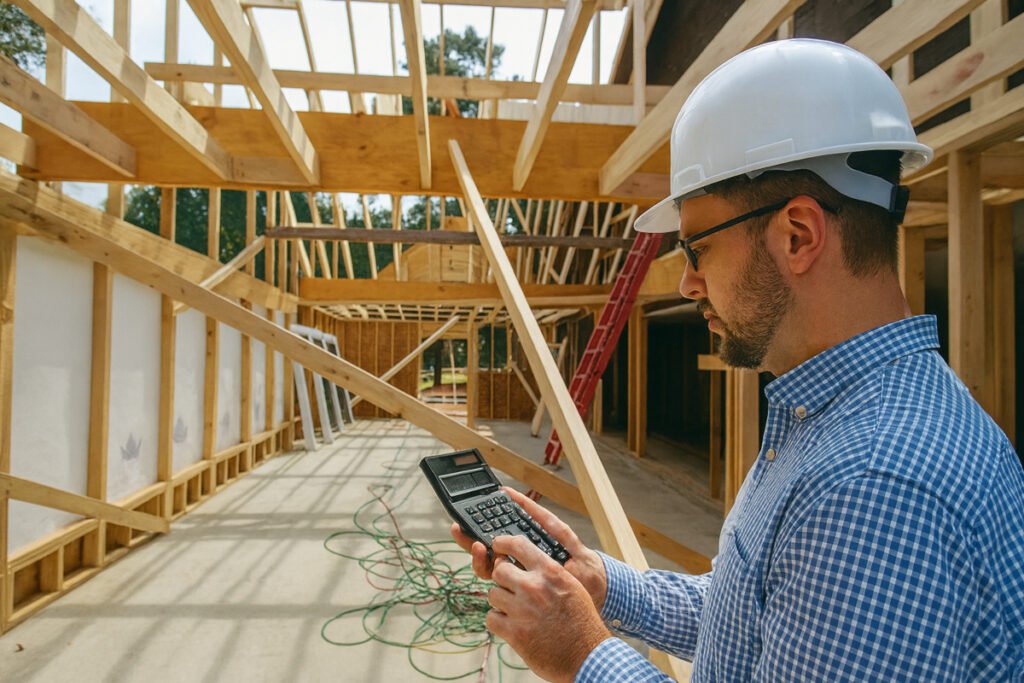
Let’s say you enter the following values in the Framing Calculator:
| Input | Value |
|---|---|
| Wall Length | 30 ft |
| Wall Height | 8 ft |
| Stud Spacing | 16″ OC |
| Corners | 2 |
| T-walls | 1 |
| Openings | 2 windows + 1 door |
Your results may look like this:
| Category | Quantity | Typical Lumber |
|---|---|---|
| Common Studs | 17 pcs | 2×4 SPF #2 |
| King Studs | 4 pcs | 2×4 SPF #2 |
| Jack Studs | 4 pcs | 2×4 SPF #2 |
| Cripple Studs | 2 pcs | 2×4 SPF #2 (cut to fit) |
| Corner Studs | 4 pcs | 2×4 SPF #2 |
| T-Wall Studs | 2 pcs | 2×4 SPF #2 |
| Top Plates | 60 LF | 2×4 SPF #2 |
| Bottom Plate | 30 LF | 2×4 SPF #2 PT |
| Blocking / Bracing | 30 LF | 2×4 SPF #2 |
| Sill Pieces | 1 pc | 2×4 SPF #2 |
| Sheathing Panels | 12 sheets | 7/16″ OSB 4×8 |
| Crew Hours | 6.1 hrs | 3-person crew |
Interpretation:
This wall section requires approximately 12 sheets of OSB and 63 studs total (including kings, jacks, and corners). A typical 3-person crew would need around 6 hours to frame it, depending on site conditions and accessibility.
🏁 Summary
The calculator produces a balanced, professional framing estimate that includes:
- All materials (studs, plates, blocking, sheathing).
- Labor hours based on productivity rates.
- Visual and JSON outputs for transparency.
- Settings customization, allowing real-world adjustments.
This approach ensures both accuracy and flexibility, whether you’re pricing a small renovation in Tyler, TX or planning a full commercial framing job.